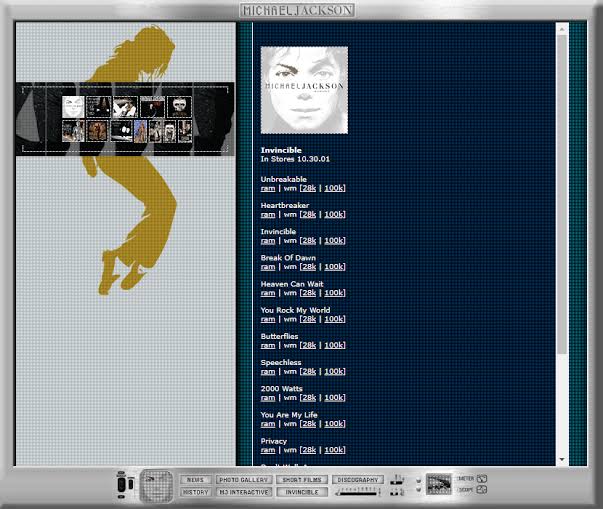
There are certain memories from the early days of the internet that feel almost dreamlike now—those moments when you’d sit at a family computer, listen to the dial-up modem screech its way to connectivity, and enter a digital world that felt vast and full of possibility. For me, one of the most magical of those experiences was visiting Michael Jackson’s official website.
—
A Portal to Another World
Michael Jackson was always among the first to embrace technological advancements in his work. At the dawn of the 2000s, when the internet was still finding its footing and the very first websites had barely a decade of history behind them—the World Wide Web had only become publicly available in 1991—Jackson already had his own official site.
Though he would often admit that he wasn’t particularly fascinated by the digital world, preferring, as he said, to curl up with a good book, his presence online was nonetheless ahead of its time. Initially, his website operated under the domain *mjjsource.com*, while the iconic *michaeljackson.com* was only acquired from Sony in 2008. But regardless of the address, the experience was unforgettable.
—
The Homepage: An Immersive Experience
Most artist websites in those days were remarkably simple—a few static pages with basic information, maybe a photo or two. Michael’s stood out because it was designed as an immersive experience rather than just a collection of pages.
By the standards of that era, the site was remarkably engaging: rich with animations, it featured Jackson on the homepage dressed in his legendary *Billie Jean* outfit. The layout was dynamic—some sections rotated on the right side of the screen, while others appeared on the left.
The homepage typically featured:
– A full-screen dark background that made everything feel cinematic and mysterious
– Large promotional images of Michael that seemed to command your attention
– An animated logo that pulsed with energy
– An intro animation that you’d wait 10–30 seconds to load—and you’d wait eagerly, because you knew something special was coming
– Background music that instantly transported you into his world
– A Flash menu that appeared after the intro, sleek and interactive
The sections were everything a fan could hope for: News, Biography, Discography, Videos, Tour information, Merchandise, Fan Club, Multimedia, Wallpapers, and Downloads.
Many visitors, myself included, remember entering the site through an animated splash screen—a digital curtain that rose to reveal something magical. The anticipation of waiting for that animation to load is something today’s instant-access generation will never quite understand.
—
The Technology Behind the Magic
The site was primarily built with technologies common at the time—HTML 4, CSS (fairly limited compared to today), JavaScript, Macromedia Flash (which was the biggest part of the experience), animated GIFs, JPEG images, and some CGI/PHP scripts for forms and news updates. But it was the Flash that made it truly special, creating animations and interactions that felt revolutionary.
In retrospect, it wasn’t just a website—it was a digital destination.
—
Surprising Discoveries
The platform offered the latest news, allowed fans to stream his music, and provided a space to watch his groundbreaking music videos. It even included an art gallery showcasing Jackson’s own paintings—a little-known fact, but he was, in truth, a wonderful artist.
I also remember online fan interactions, where questions were occasionally answered. In one memorable exchange, Michael was asked whether he would ever perform a concert in Egypt. He explained that the available venue was simply too small for the audience he expected
—
The Human Connection
However, most of the direct interaction with fans actually came through his assistant and makeup artist, Karen Faye. I myself had the pleasure of communicating with Karen and asking her questions on several occasions. It made the whole experience feel more personal, more real.
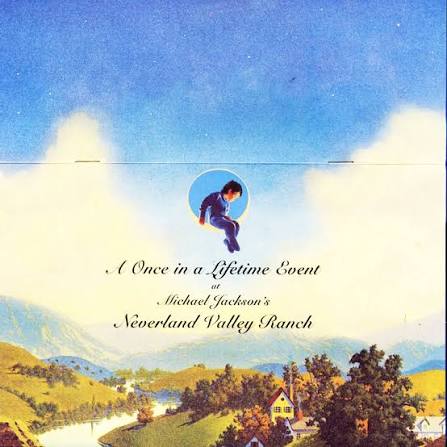
I think about the fact that many may not know, that In 2003, Michael Jackson sold “once-in-a-lifetime” access to Neverland Valley Ranch through a $2.500 per person “Enchanted Day” ticket for a Sept. 13 charity event. While he occasionally invited fans to his private estate for free, he never established permanent public tours.
—
The internet has changed immeasurably since then. Websites are faster, cleaner, and more functional. But they’ve also lost something—a certain sense of wonder, of anticipation, of discovery. Michael Jackson’s site in the 2000s had that magic in abudence.